
For a straightforward, portable option with broad everyday appeal, I’d start with the AUVON Dual Channel TENS Unit; its two channels and 20 modes offer flexibility without relying on a wireless-only setup. The OMRON Max Power Relief stands out for buyers who prefer a focused TENS device, while the Comfytemp Wireless TENS Unit with 30 Modes suits people who want fewer wires and a wider choice of programs. The main tradeoffs are wired control versus wireless convenience, TENS-only simplicity versus added EMS functions, and pad quantity versus ease of managing a session. I compare all 15 options by usability, versatility, portability, and practical limitations so you can match the device to how you plan to use it. Read on for the full breakdown and buying advice.

Get health and wellness essentials delivered free with Prime
- Fast, free delivery on millions of items
- Prime Video, Amazon Music and more included
- Member-only deals all year
Key Takeaways
Dual-channel models offer the clearest flexibility advantage: the AUVON Dual Channel and Belifu Dual-Channel units can support use across two areas, while buyers should check whether independent channel control matters for their routine.
Wireless convenience comes with a different control tradeoff: AUVON and Comfytemp wireless picks reduce lead clutter, but a traditional wired unit may feel easier to adjust and manage during a session.
More modes do not automatically mean a better fit: models listing 30 or 40 intensity levels may offer more ways to tune stimulation, but simple controls can matter more to first-time users.
Pad counts vary widely across the lineup: options range from six pads to 20, which can affect placement flexibility and replacement planning, but extra pads are only useful if they suit the body areas you intend to treat.
TENS/EMS combinations add versatility, not a universal upgrade: they may appeal to buyers seeking muscle stimulation alongside TENS, while a TENS-focused model such as the OMRON may better suit someone seeking a more straightforward pain-relief device.
| TENS 7000 Digital TENS Unit with Accessories | 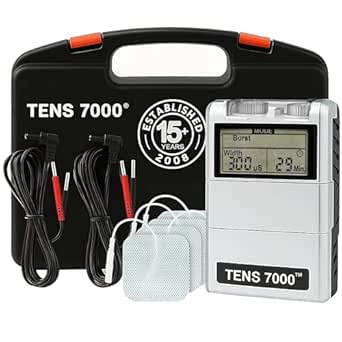 | Best for a Ready-to-Use Wired Kit | Model: TENS 7000 | Manufacturer: Roscoe Medical | Power: One included 9V battery | VIEW LATEST PRICE | See Our Full Breakdown |
| TENKER Rechargeable TENS Unit with 24 Modes and 8 Electrode Pads |  | Best Value for Flexible Wired Sessions | Modes: 24 | Intensity levels: 20 | Output channels: 2 | VIEW LATEST PRICE | See Our Full Breakdown |
| NURSAL Rechargeable TENS and EMS Muscle Stimulator with 8 Electrode Pads |  | Best for Timed, Customizable Sessions | Stimulation types: TENS and EMS | Modes: 24 | Intensity levels: 20 | VIEW LATEST PRICE | See Our Full Breakdown |
| AVCOO TENS and EMS Muscle Stimulator with 12 Electrode Pads |  | Best Compact Wired Pick | Functions: TENS and EMS | Modes: 30 | Intensity levels: 30 | VIEW LATEST PRICE | See Our Full Breakdown |
| AUVON Wireless TENS Unit Muscle Stimulator with 6 Electrode Pads |  | Best Wireless Pick | Modes: 24 | Intensity levels: 30 | Session duration: 10–90 minutes; 30-minute default | VIEW LATEST PRICE | See Our Full Breakdown |
| AUVON Dual Channel TENS Unit Muscle Stimulator with 20 Modes and Electrode Pads |  | Best for Independent Two-Area Control | Type: Rechargeable dual-channel TENS unit | Modes: 20 preset modes | Channel controls: Independent mode and intensity settings for channels A and B | VIEW LATEST PRICE | See Our Full Breakdown |
| Comfytemp Wireless TENS Unit Muscle Stimulator with 30 Modes |  | Best for Wireless App Control | Device type: Wireless TENS unit | Modes: 30 | Intensity levels: 20 | VIEW LATEST PRICE | See Our Full Breakdown |
| AUVON 24-Mode TENS Unit Muscle Stimulator |  | Best for Long Sessions Between Charges | Modes: 24 preset sub-modes across 6 massage modes | Battery: Rechargeable lithium battery | Battery life: Up to 10 hours | VIEW LATEST PRICE | See Our Full Breakdown |
| AUVON 3-in-1 TENS Unit Muscle Stimulator with 40 Intensity Levels |  | Best for Fine Intensity Adjustment | Functions: TENS, EMS, and RELAX | Intensity levels: 40 | Preset modes: 24 | VIEW LATEST PRICE | See Our Full Breakdown |
| AVCOO 3-in-1 TENS EMS Muscle Stimulator with 30 Modes |  | Best for Extended Battery Runtime | Therapy types: TENS, EMS, and RELAX | Modes: 30 | Intensity levels: 40 | VIEW LATEST PRICE | See Our Full Breakdown |
| Comfytemp 3-in-1 Rechargeable TENS and EMS Muscle Stimulator |  | Best for Customizable Sessions | Therapies: TENS and EMS | Modes: 20 total, including 4 customizable DIY presets | Intensity levels: 20 | VIEW LATEST PRICE | See Our Full Breakdown |
| OMRON Max Power Relief TENS Unit Muscle Stimulator |  | Best for Straightforward Operation | Model: PM500 | Therapy modes: Pain and massage | Session duration: 15 minutes; up to 30 minutes per session | VIEW LATEST PRICE | See Our Full Breakdown |
| Comfytemp Wireless TENS Unit and Muscle Stimulator with 30 Modes |  | Best Wireless Pick | Stimulation types: TENS and muscle stimulation | Modes: 30 | Intensity levels: 20 | VIEW LATEST PRICE | See Our Full Breakdown |
| Comfytemp Dual-Channel TENS Unit with Specialized Pads |  | Best for Broad Body-Area Coverage | Display: 2.76-inch | Modes: 20 | Intensity levels: 20 | VIEW LATEST PRICE | See Our Full Breakdown |
| Belifu Dual-Channel TENS EMS Unit with 24 Modes and 10 Reusable Pads |  | Best Pocket-Size Value | Channels: Dual | Modes: 24 preset modes | Intensity levels: 20 | VIEW LATEST PRICE | See Our Full Breakdown |
| portable TENS units for pain relief | Electrode pads | Modes | Intensity levels |
|---|---|---|---|
| TENS 7000 Digital TENS Unit wi | 4 reusable pads | — | — |
| TENKER Rechargeable TENS Unit | 8 total: 6 square 2-inch pads and 2 pads measuring 2 × 4 inches | 24 | 20 |
| NURSAL Rechargeable TENS and E | 8 reusable pads | 24 | 20 |
| AVCOO TENS and EMS Muscle Stim | 12 snap-button pads in three shapes and sizes | 30 | 30 |
| AUVON Wireless TENS Unit Muscl | 6 latex-free pads: 4 small and 2 large | 24 | 30 |
| AUVON Dual Channel TENS Unit M | 4 square 2 x 2 in pads and 4 rectangular 2 x 4 in pads | 20 preset modes | — |
| Comfytemp Wireless TENS Unit M | 4: 2 butterfly-shaped and 2 line-shaped | 30 | 20 |
| AUVON 24-Mode TENS Unit Muscle | 8 square pads; adhesive rated for up to 45 uses | 24 preset sub-modes across 6 massage modes | — |
| AUVON 3-in-1 TENS Unit Muscle | 8 square 2-inch pads and 4 rectangular 2 x 4-inch pads | — | 40 |
| AVCOO 3-in-1 TENS EMS Muscle S | 12 latex-free pads in multiple shapes | 30 | 40 |
| Comfytemp 3-in-1 Rechargeable | — | 20 total, including 4 customizable DIY presets | 20 |
| OMRON Max Power Relief TENS Un | — | — | — |
| Comfytemp Wireless TENS Unit a | 4 medical PET pads: 2 butterfly and 2 line pads | 30 | 20 |
| Comfytemp Dual-Channel TENS Un | Neck and shoulder pad, lower-back pad, and 6 universal pads | 20 | 20 |
| Belifu Dual-Channel TENS EMS U | — | 24 preset modes | 20 |
More Details on Our Top Picks
TENS 7000 Digital TENS Unit with Accessories
The TENS 7000 makes the most sense for buyers who want a conventional, self-contained kit rather than a wireless setup. It comes with two lead wires, four reusable electrode pads, a 9V battery, and a hard carrying case, so the basic accessories are included from the start. Multiple therapy modes offer some flexibility, though the supplied details do not specify how many modes or intensity levels are available. Compared with the TENKER Rechargeable TENS Unit, this model avoids charging cables and rechargeable-battery runtime limits, but it relies on a replaceable 9V battery instead. Its case also makes it easier to keep the parts together, while the wired leads mean it is less convenient under clothing or during movement. I’d choose it for straightforward portable sessions, not for wireless freedom or detailed mode selection.
Pros:- Includes two lead wires and four reusable electrode pads
- Multiple therapy modes provide more than one stimulation approach
- Comes with a hard carrying case for organizing and transporting accessories
- Includes a 9V battery for initial setup
Cons:- Uses a 9V battery rather than a rechargeable power source
- Wired leads can be less convenient during movement than wireless options
- The supplied product details do not state the number of modes or intensity levels
Best for: Buyers who want a traditional wired TENS kit with the key accessories and a protective case included.
Not ideal for: People who prioritize wireless wear, rechargeable power, or clearly specified mode and intensity options.
- Model:TENS 7000
- Manufacturer:Roscoe Medical
- Power:One included 9V battery
- Included leads:2 lead wires
- Electrode pads:4 reusable pads
- Included storage:Hard carrying case
- Dimensions:8.75 × 2 × 7.75 inches
- Weight:13.7 ounces
Our verdict“Choose the TENS 7000 if you want a wired portable kit with a case and starter accessories, and skip it if rechargeable or wireless use matters most.”
TENKER Rechargeable TENS Unit with 24 Modes and 8 Electrode Pads
The TENKER Rechargeable TENS Unit balances adjustable sessions with a useful pad assortment. Its 24 modes and 20 intensity levels give buyers more ways to tailor stimulation than the TENS 7000, whose supplied details do not specify those controls. Two output channels can serve two treatment areas or two users, and the eight pads come in both square and larger rectangular sizes for different placement needs. The manufacturer states up to 10 hours of use per charge, making it a practical travel option without carrying spare batteries. It remains a wired device, though, so it lacks the uncluttered wear of the wireless AUVON Wireless TENS Unit. The USB cable is included, but the charging adapter is not. I’d pick TENKER for feature flexibility in a traditional handheld format, not for cable-free movement.
Pros:- Offers 24 modes and 20 intensity levels
- Two output channels support two treatment areas or two users
- Manufacturer states up to 10 hours of use per charge
- Includes eight pads in two sizes
Cons:- USB charging adapter is not included
- Lead wires make it less convenient to wear during movement than the wireless AUVON option
- Manufacturer advises against use by people with pacemakers, pregnant people, and people with epilepsy
Best for: People who want rechargeable power, adjustable modes, and enough pads to treat more than one area with a wired device.
Not ideal for: Buyers who need a wireless unit, expect a wall adapter in the box, or fall into a group the manufacturer advises against using it, including people with pacemakers, pregnant people, and people with epilepsy.
- Modes:24
- Intensity levels:20
- Output channels:2
- Electrode pads:8 total: 6 square 2-inch pads and 2 pads measuring 2 × 4 inches
- Battery:Rechargeable lithium battery
- Stated battery life:Up to 10 hours per charge
- Charging:USB cable included; adapter not included
- Warranty:12 months
Our verdict“Pick TENKER for rechargeable, adjustable wired sessions and a broad pad selection, but choose a wireless model if freedom from leads is your priority.”
NURSAL Rechargeable TENS and EMS Muscle Stimulator with 8 Electrode Pads
The NURSAL Rechargeable TENS and EMS stands out for session controls that go beyond selecting a mode and intensity. Its adjustable 10–60 minute timer, screen lock, and memory function can make repeat sessions easier to manage and reduce accidental button changes. Like the TENKER, it has two outputs, 24 modes, 20 intensity levels, and eight reusable pads, so the choice between them comes down less to channel count and more to controls and included accessories. NURSAL adds a pad holder alongside its pouch and USB cable, while the TENKER provides a stated battery life of up to 10 hours. NURSAL’s product details give no runtime or charging-time estimate, which makes trip planning less predictable. The stated pad lifespan is also up to 40 uses. I’d favor it for structured sessions, not for buyers who need clear battery-runtime information.
Pros:- Combines TENS and EMS stimulation
- Adjustable 10–60 minute timer, memory function, and screen lock support controlled sessions
- Two outputs and 24 modes with 20 intensity levels
- Includes eight reusable pads, a pad holder, and a pouch
Cons:- No charging time or battery runtime is provided
- Electrode pads are described as reusable for up to 40 uses
- Wired lead connections are less convenient for movement than the wireless AUVON unit
Best for: People who prefer timed, repeatable TENS or EMS sessions and want a screen lock and memory function.
Not ideal for: Travelers who need a stated battery runtime or buyers who want a documented pad lifespan longer than the stated limit of up to 40 uses.
- Stimulation types:TENS and EMS
- Modes:24
- Intensity levels:20
- Timer:10–60 minutes; 20-minute default
- Outputs:2
- Electrode pads:8 reusable pads
- Power:Rechargeable lithium battery
- Included accessories:Lead wires, USB cable, pad holder, pouch, and user manual
Our verdict“Choose NURSAL if session timing and repeatable settings matter more than battery-runtime certainty or wireless convenience.”
AVCOO TENS and EMS Muscle Stimulator with 12 Electrode Pads
At 4.8 × 1.3 × 0.5 inches and 0.09 lb, the AVCOO is the lineup’s clearest fit for buyers who want a very small wired unit to carry between sessions. It also offers 30 modes and 30 intensity levels, more of each than the TENKER and NURSAL models, and includes 12 latex-free pads in three shapes. That variety can help when a buyer wants different pad sizes for different treatment areas, while the stated battery use of up to 30 hours reduces the need for frequent charging. The tradeoff is that the supplied information does not specify charging time, and the pads need replacement after repeated use despite their stated lifespan of more than 50 uses. Compared with the wireless AUVON, AVCOO stays compact but retains lead wires. I’d choose it for a small, feature-rich kit rather than cable-free wear.
Pros:- Very compact at 4.8 × 1.3 × 0.5 inches and 0.09 lb
- Offers 30 modes and 30 intensity levels
- Combines TENS and EMS functions
- Includes 12 latex-free pads in three shapes and sizes
Cons:- Charging time is not provided
- Electrode pads need replacement after repeated use, with reuse stated as more than 50 uses
- Wired operation is less convenient during movement than the wireless AUVON
Best for: Travelers who want a lightweight wired TENS and EMS unit with multiple pad shapes and many adjustment levels.
Not ideal for: People who want wireless treatment or need a stated charging time before planning sessions away from home.
- Functions:TENS and EMS
- Modes:30
- Intensity levels:30
- Channels:Dual-channel
- Weight:0.09 lb
- Dimensions:4.8 × 1.3 × 0.5 inches
- Electrode pads:12 snap-button pads in three shapes and sizes
- Stated battery use:Up to 30 hours
Our verdict“Choose AVCOO if a small, lightweight wired unit and varied pad shapes matter more than wireless operation or a specified charging schedule.”
AUVON Wireless TENS Unit Muscle Stimulator with 6 Electrode Pads
The AUVON Wireless TENS Unit is the strongest choice here for buyers who want to avoid lead wires during a session. Its two pods attach to the included pads, while the rechargeable case provides a portable way to top them up; that design is more convenient for movement than the wired AVCOO or TENKER units. Buyers still get 24 modes and 30 intensity levels, plus a timer adjustable from 10 to 90 minutes. The main limit is pod runtime: each runs for up to eight hours per charge, even though the case is stated to provide up to 40 hours of power. Its six pads are rated for up to 45 uses, so replacements will be part of ongoing ownership. The manufacturer advises against use by people with pacemakers, pregnant people, or people with epilepsy. I’d select it for cable-free portability, not maximum pad quantity or continuous pod runtime.
Pros:- Wireless two-pod design avoids lead wires during use
- Rechargeable case is stated to provide up to 40 hours of power
- Offers 24 modes, 30 intensity levels, and a 10–90 minute session timer
- Includes six latex-free pads in two sizes
Cons:- Each pod runs for up to 8 hours per charge
- Pads are rated for up to 45 uses
- Manufacturer advises against use by people with pacemakers, pregnant people, and people with epilepsy
Best for: People who want a portable, cable-free TENS and EMS setup for sessions where dangling lead wires would get in the way.
Not ideal for: Buyers who need long uninterrupted use from each device charge, want more than six pads included, or fall into a group the manufacturer advises against using it.
- Modes:24
- Intensity levels:30
- Session duration:10–90 minutes; 30-minute default
- Charging case battery:790 mAh
- Stated charging case runtime:Up to 40 hours
- Stated pod runtime:Up to 8 hours
- Electrode pads:6 latex-free pads: 4 small and 2 large
- Charging connection:USB Type-C
- Coverage and support:24-month quality coverage and lifetime customer support
Our verdict“Choose AUVON for wire-free portability and a charging case, but opt for a wired model if longer per-charge use or a larger pad set matters more.”
AUVON Dual Channel TENS Unit Muscle Stimulator with 20 Modes and Electrode Pads
The AUVON’s strongest case is its independent controls for two channels: you can set each side to a different mode and intensity, which suits sessions covering two areas with different comfort needs. Its 20 preset modes give more choices than a basic unit, while two pad sizes make placement more flexible across areas such as the back, shoulder, knee, or elbow. Compared with the AUVON 24-Mode TENS Unit, this model offers fewer presets and does not list a battery-life figure, but it includes the same practical two-lead setup and a 24-month warranty. The tradeoff is a wired design and pad adhesive rated for up to 45 uses, so it is less convenient for moving around than the wireless Comfytemp. Follow the listed safety guidance and consult a clinician if you have a medical condition.
Pros:- Independent mode and intensity controls for channels A and B
- 20 preset modes to vary the stimulation session
- Includes both square and rectangular reusable pads
- Rechargeable design, USB cable, storage pouch, and 24-month warranty
Cons:- Wired leads can restrict movement during a session
- Pad adhesive is rated for up to 45 uses
- Battery runtime is not specified, and the product is unsuitable for some users
Best for: People who want to treat two areas at once and adjust each channel separately, with a compact wired setup for home sessions.
Not ideal for: People who need wireless movement during treatment, or anyone who wants a stated battery-runtime estimate; listed cautions also exclude people with pacemakers, pregnant women, and people with epilepsy.
- Type:Rechargeable dual-channel TENS unit
- Modes:20 preset modes
- Channel controls:Independent mode and intensity settings for channels A and B
- Electrode pads:4 square 2 x 2 in pads and 4 rectangular 2 x 4 in pads
- Pad reuse:Up to 45 uses
- Included accessories:2 lead wires, USB cable, user manual, pad holder, and pouch
- Warranty:24 months
Our verdict“Choose this AUVON if separate settings for two treatment areas matter more than wireless freedom or a larger preset selection.”
Comfytemp Wireless TENS Unit Muscle Stimulator with 30 Modes
This Comfytemp is the movement-friendly choice: its wireless hosts avoid lead wires running between the controller and pads, while app control lets you adjust a session from a phone. It offers 30 modes and 20 intensity levels, plus two hosts and four pads, so it can cover more than one placement without carrying a separate wired controller. Compared with the AUVON Dual Channel TENS Unit, it trades independent wired-channel controls for a more portable setup and app-based operation. That app is also its main limitation: no remote is included, so buyers who do not want a phone involved should choose a button-controlled unit instead. The pads are described as reusable for over 60 cycles and can be rinsed to renew adhesion, though their listed dimensions do not include units. App registration is not required.
Pros:- Wireless design avoids lead wires that can limit movement
- 30 modes and 20 intensity levels offer session adjustments
- Includes two device hosts and four reusable pads
- Pads can be rinsed and are described as reusable for over 60 cycles
Cons:- App is the control method; no remote is included
- Pad dimensions are listed without units
- Wireless operation depends on using a compatible mobile app
Best for: Phone-comfortable users who want a compact, wireless TENS setup for at-home sessions or treatment while moving around.
Not ideal for: Buyers who want a physical remote or prefer not to operate a therapy device through a smartphone; skip it if pad dimensions need to be confirmed precisely before purchase.
- Device type:Wireless TENS unit
- Modes:30
- Intensity levels:20
- Control:Mobile app; registration not required
- Device hosts:2
- Electrode pads:4: 2 butterfly-shaped and 2 line-shaped
- Pad reuse:Over 60 cycles
- Power:Rechargeable
Our verdict“Pick this Comfytemp if wireless wear and phone control are more useful to you than a physical controller or wired channel setup.”
AUVON 24-Mode TENS Unit Muscle Stimulator
For buyers who want predictable session planning, this AUVON pairs up to 10 hours of use per charge with an approximately one-hour recharge time. Its 24 preset sub-modes across six massage modes give more variation than the AUVON Dual Channel TENS Unit’s 20 presets, and the eight included pads mean there are extras available for placement changes. The USB-C charging and included pouch also suit a portable kit, though this remains a wired unit rather than a hands-free wireless option like the Comfytemp Wireless TENS Unit. The tradeoff is that its mode count and battery life do not make it a three-function TENS/EMS device; the AUVON 3-in-1 offers broader therapy types and more intensity levels. Pad adhesive is rated for up to 45 uses, and listed safety cautions apply.
Pros:- Up to 10 hours of use per charge
- Approximately one-hour recharge time
- 24 preset sub-modes across six massage modes
- Eight reusable pads and a USB-C cable are included
Cons:- Wired leads limit freedom of movement during use
- Pad adhesive is rated for up to 45 uses
- Does not list EMS or RELAX as separate therapy functions
Best for: People who want a rechargeable wired TENS unit for regular or longer sessions and value a stated runtime with spare pads.
Not ideal for: Buyers seeking wireless treatment, TENS and EMS functions in one device, or users covered by the listed restrictions for pacemakers, pregnancy, or epilepsy.
- Modes:24 preset sub-modes across 6 massage modes
- Battery:Rechargeable lithium battery
- Battery life:Up to 10 hours
- Recharge time:Approximately 1 hour
- Electrode pads:8 square pads; adhesive rated for up to 45 uses
- Lead wires:2
- Charging cable:USB-C
- Warranty:12 months
Our verdict“Choose this AUVON for a wired TENS unit with a stated 10-hour runtime, not for wireless use or multiple therapy types.”
AUVON 3-in-1 TENS Unit Muscle Stimulator with 40 Intensity Levels
The AUVON 3-in-1 stands out for the 40 intensity levels, giving buyers more adjustment steps than the 20-level Comfytemp Wireless TENS Unit. Its TENS, EMS, and RELAX functions also make it a broader-use device than the AUVON 24-Mode TENS Unit, which focuses on TENS modes. With dual channels and a mix of square and rectangular pads, it can support different placements and two treatment areas. The adjustable timer runs up to 90 minutes, a useful limit for setting a session without repeatedly checking the clock. The tradeoff is that battery runtime and adapter inclusion are not specified, unlike the AUVON 24-Mode’s stated 10-hour use. Its pad adhesive is described as lasting up to 45 uses, so ongoing pad replacement is part of ownership.
Pros:- Combines TENS, EMS, and RELAX functions
- 40 intensity levels allow smaller adjustment steps
- Dual channels and two pad shapes support flexible placement
- USB-C charging, storage pouch, and 24-month warranty
Cons:- Battery life is not specified
- Power adapter inclusion is not stated
- Pad adhesive is described as lasting up to 45 uses
Best for: People who want TENS alongside EMS and relaxation modes, with many intensity steps and dual-channel placement options.
Not ideal for: Buyers who need a documented battery runtime or a clearly specified power adapter, or who want a wireless, lead-free setup.
- Functions:TENS, EMS, and RELAX
- Intensity levels:40
- Preset modes:24
- Channels:Dual channel
- Therapy timer:Adjustable up to 90 minutes
- Electrode pads:8 square 2-inch pads and 4 rectangular 2 x 4-inch pads
- Included accessories:2 lead wires, pad holders, USB-C cable, user manual, and storage pouch
- Warranty:24 months
- Body material:Aluminum alloy
Our verdict“Choose this AUVON if fine intensity adjustment and three therapy functions matter more than a confirmed battery runtime.”
AVCOO 3-in-1 TENS EMS Muscle Stimulator with 30 Modes
The AVCOO’s clearest advantage for portable pain-relief sessions is its battery rated for up to 40 hours, far beyond the AUVON 24-Mode TENS Unit’s stated 10 hours. It also combines TENS, EMS, and relaxation modes, with 30 modes, 40 intensity levels, and dual channels for varied settings across two areas. Twelve latex-free pads provide more included placement options than the four-pad Comfytemp Wireless TENS Unit, though AVCOO uses a wired dual-channel design rather than wireless hosts. Its pads are described as lasting over 50 uses, a longer stated lifespan than the 45-use pads listed for the AUVON models. The tradeoff is missing physical detail: dimensions and device weight are not provided, and the product description does not say how long a session can run. Treatment results can vary by person and use.
Pros:- Battery is rated for up to 40 hours
- Includes TENS, EMS, and RELAX therapy types
- Dual channels, 30 modes, and 40 intensity levels
- Twelve latex-free pads are described as lasting over 50 uses
Cons:- Device dimensions and weight are not specified
- Wired leads may restrict movement during treatment
- Treatment session length is not specified
Best for: People who want a rechargeable, multi-function wired unit for frequent sessions and place high value on long stated battery life and a larger pad set.
Not ideal for: Buyers who need a compactness or weight estimate before choosing, or who want wireless treatment without lead wires.
- Therapy types:TENS, EMS, and RELAX
- Modes:30
- Intensity levels:40
- Channels:Dual channel (A/B)
- Battery life:Up to 40 hours
- Electrode pads:12 latex-free pads in multiple shapes
- Pad adhesive durability:Over 50 uses
- Charging:USB; compatible with wall charger, power bank, or laptop
- Warranty:24 months
Our verdict“Pick the AVCOO if long stated runtime and a large latex-free pad set outweigh the need for wireless use or published device dimensions.”
Comfytemp 3-in-1 Rechargeable TENS and EMS Muscle Stimulator
For buyers who want control over both treatment settings and placement, the Comfytemp 3-in-1 stands out with 20 modes, four DIY presets, and independent dual channels. That lets you adjust two treatment areas separately rather than settling for one shared intensity. Its 10 included pads offer more placement options than the two-pad OMRON Max Power Relief, while the up-to-21-hour rechargeable battery avoids carrying spare AAA batteries. A 3-inch screen, key lock, memory, and clip make it practical to manage between sessions or take along. The tradeoff is a busier feature set than a simpler unit, and reusable pads may need cleaning to restore adhesion. I’d choose it for flexible, repeated use, not for someone who wants the most straightforward controls.
Pros:- Independent channels allow separate intensity settings for two areas
- Four DIY presets add flexibility beyond the 20 listed modes
- Rechargeable battery is rated for up to 21 hours per charge
- Ten pads in two sizes support varied placement
Cons:- Reusable pad adhesion may need maintenance through rinsing and cleaning
- The many settings may feel less simple than the OMRON Max Power Relief
Best for: People who want to tailor stimulation for two areas and carry a rechargeable unit between home and work
Not ideal for: First-time users seeking a minimal control layout, or anyone unwilling to clean reusable pads as adhesion fades
- Therapies:TENS and EMS
- Modes:20 total, including 4 customizable DIY presets
- Intensity levels:20
- Channels:2 independent channels (A/B)
- Display:3-inch HD screen
- Timer:10–60 minutes
- Battery life:Up to 21 hours per charge
- Included pads:10 reusable medical PET pads: 2 large and 8 small
- Portability features:Rechargeable; key lock, memory function, and belt/pocket clip
Our verdict“Choose this Comfytemp if you want a rechargeable unit with customizable settings and independent control for two treatment areas.”
OMRON Max Power Relief TENS Unit Muscle Stimulator
The OMRON Max Power Relief is the simplest fit here for buyers who prefer a limited set of controls over a long list of modes. It offers pain and massage modes, adjustable intensity, and a clear display, with AAA batteries and the basic accessories included. Compared with the rechargeable Comfytemp 3-in-1, it gives you fewer choices and no second independently controlled channel, but that narrower setup may feel easier to manage for occasional sessions. Its washable pads are rated for up to 150 uses, though the package includes only two, limiting placement options compared with the Belifu’s 10 pads. The session limits also make it a less flexible choice for longer use: it allows up to 30 minutes per session and up to three sessions daily. This is a focused, portable option rather than a feature-rich system.
Pros:- Pain and massage modes keep the control choices straightforward
- Includes two AAA batteries and accessories for use out of the box
- Washable pads are rated for up to 150 uses
- Portable design has a clear display and intuitive controls
Cons:- Only two pads are included, fewer than the Belifu and Comfytemp wired units
- Use is limited to 30 minutes per session and up to three sessions daily
- Pads are intended for one patient only
Best for: People seeking a familiar, battery-powered TENS unit with simple pain and massage settings for occasional use
Not ideal for: Users who want long sessions, multiple electrode placements, or independently controlled channels
- Model:PM500
- Therapy modes:Pain and massage
- Session duration:15 minutes; up to 30 minutes per session
- Maximum use:Up to 3 sessions daily
- Pads:2 reusable, washable pads rated for up to 150 uses
- Power:2 AAA batteries
- Included accessories:Pad holder, electrode cords, instruction manual, quick-start guide, and pad-placement guide
Our verdict“Pick the OMRON if you value simple controls and included batteries more than extra channels, pads, or extended sessions.”
Comfytemp Wireless TENS Unit and Muscle Stimulator with 30 Modes
If electrode wires are the main obstacle to using a portable TENS unit, this wireless Comfytemp offers a different kind of convenience from the corded Belifu Dual-Channel TENS EMS Unit. Its two wireless units can be placed on separate areas, while remote or on-unit controls let you change settings without managing lead wires. Thirty modes and 20 intensity levels give it a broad range of adjustments, and the included case helps keep the two units and pads together. The package has four reusable pads in butterfly and line shapes, but that is fewer pads than the Comfytemp 3-in-1’s 10-pad kit. Pad adhesion may also require rinsing and air-drying, so wireless operation does not remove routine upkeep. This makes the most sense for movement and convenience, not for buyers who prioritize a large pad supply.
Pros:- Wireless units avoid managing electrode lead wires
- Remote and on-unit buttons provide two ways to control settings
- Thirty modes and 20 intensity levels offer adjustment choices
- Includes two pad shapes and a carrying case
Cons:- Four pads are included, fewer than the Comfytemp 3-in-1’s 10
- Pads may need rinsing and air-drying to renew adhesion
Best for: People who want to move around during use and prefer wireless units over electrode leads
Not ideal for: Buyers who need many pads for several placement points or want to avoid reusable-pad upkeep
- Stimulation types:TENS and muscle stimulation
- Modes:30
- Intensity levels:20
- Controls:Remote control and buttons on each unit
- Included units:2 wireless units
- Electrode pads:4 medical PET pads: 2 butterfly and 2 line pads
- Pad reuse:60+ cycles
- Included accessory:Carrying case
Our verdict“Choose this model if freedom from wires matters more to you than having a larger pad assortment.”
Comfytemp Dual-Channel TENS Unit with Specialized Pads
This Comfytemp is the most body-area-specific choice in the group: its oversized neck, shoulder, and lower-back pads are designed to cover broader zones than the small universal pads supplied with the Belifu Dual-Channel unit. Six additional universal pads give you other placement options, and independent A/B controls let you set separate intensities across two channels. The 2.76-inch display and simplified button layout aim to keep those adjustments manageable, while a carrying case helps organize the kit for travel. The tradeoff is less clarity around ongoing ownership: replacement pads are sold separately, and the product details do not state battery type or runtime. Compared with the Comfytemp 3-in-1, it emphasizes specialized pad coverage rather than a stated long battery life or DIY presets.
Pros:- Oversized pads provide broader coverage for neck, shoulders, and lower back
- Six universal pads add placement flexibility
- Independent channels allow separate A/B intensity adjustments
- Carrying case keeps the device and pads together
Cons:- Replacement pads are sold separately
- Battery type and runtime are not specified
Best for: People seeking larger pads for neck, shoulder, or lower-back areas, with universal pads for additional placements
Not ideal for: Travelers who need a known battery runtime or buyers who want replacement pads included in the kit
- Display:2.76-inch
- Modes:20
- Intensity levels:20
- Channels:Dual, with independent A/B controls
- Electrode pads:Neck and shoulder pad, lower-back pad, and 6 universal pads
- Controls:Simplified button layout
- Included accessory:Carrying case
Our verdict“Pick this Comfytemp if broad coverage for the neck, shoulders, or lower back matters more than detailed battery information.”
Belifu Dual-Channel TENS EMS Unit with 24 Modes and 10 Reusable Pads
The pocket-size Belifu brings together the features many portable-unit buyers need without the larger display or specialized pads found on some Comfytemp models. It has 24 preset modes, 20 intensity levels, and dual channels with separate intensity settings, so two areas can be treated without sharing one adjustment. Its rechargeable lithium battery charges by USB, and the 10 included pads make this a more placement-ready kit than the OMRON Max Power Relief, which comes with two. The compromise is pad longevity: Belifu lists use of up to 50 times, shorter than the OMRON’s stated 150 uses for its washable pads. A storage bag and cable ties help keep the compact setup organized, but this unit does not offer the wireless convenience of the Comfytemp wireless model.
Pros:- Pocket-size form and USB charging suit portable use
- Dual channels support separate intensity settings
- Ten included pads offer more placement options than the OMRON’s two
- Storage bag and cable ties help organize the kit
Cons:- Pads are described as lasting up to 50 uses
- Corded setup lacks the movement-friendly design of the wireless Comfytemp
Best for: Travelers who want a compact rechargeable kit with dual channels and enough pads for several placement points
Not ideal for: People who want wireless treatment or pads with a longer stated use life
- Channels:Dual
- Modes:24 preset modes
- Intensity levels:20
- Power:Rechargeable lithium battery with USB charging
- Included pads:10 reusable adhesive pads
- Pad use:Up to 50 uses
- Included accessories:Dust-proof drawstring storage bag and cable ties
- Portability:Pocket-size
Our verdict“Choose the Belifu for a compact, rechargeable wired kit with dual channels and a generous pad count.”

How We Picked
I compared these 15 portable TENS units by the factors that most affect real buying decisions: whether controls seem approachable, how many channels and modes are offered, what pad setup comes in the box, and whether the design prioritizes wired simplicity or wireless mobility. I also separated TENS-focused devices from TENS/EMS combinations, since extra functions can add flexibility but may make a unit less direct for someone seeking pain relief alone. Portability mattered alongside session control: a compact or wireless design can reduce setup friction, while a wired unit may be easier to adjust without handling a separate electrode module.
The ranking favors products with a useful balance of control, flexibility, and practical setup rather than the largest number of modes or pads by itself. I gave distinct roles to models that suit different priorities, including beginner-friendly operation, wireless use, broad channel control, and value. Product names and listed features guide the comparison, but individual comfort and suitability can vary; buyers should follow the device instructions and consult a healthcare professional when pain is persistent or when they have a condition that may affect TENS use.
Factors to Consider When Choosing Portable TENS Units For Pain Relief
Before choosing a portable TENS unit, decide what would make you use it consistently: uncomplicated setup, flexible placement, reduced wires, or multiple stimulation functions. The right choice depends less on the biggest feature list and more on matching the controls and electrode arrangement to your routine.
Choose Wired or Wireless Around Your Session Routine
Wireless units can reduce dangling leads and make movement around the home less cumbersome, but their electrode modules still need secure placement and charging. Wired devices keep the controls connected to the pads, which can make changes during a session more direct. A common mistake is treating “wireless” as a guarantee that the unit will stay put during every activity; fit, clothing, and pad placement still matter. If you plan to sit or rest during use, leads may be a minor inconvenience rather than a deciding issue. If you value fewer cables while moving gently, wireless may justify a more involved setup. Choose based on where and how you expect to use the device, not just the portability label.
Match Channels and Pads to the Areas You Want to Treat
More channels can provide options for placing electrodes across more than one area, while a larger pad bundle can give you more placement combinations or spare pads. Those features do not automatically mean stronger or more effective relief. Check the device instructions for compatible electrode arrangements and avoid assuming that any pad count supports simultaneous treatment of multiple body areas. Extra pads also create storage and replacement needs, so a large bundle may be unnecessary if your routine is limited to one area. Buyers with changing placement needs may value flexibility; buyers with a consistent setup may prefer fewer pieces to manage. Think through the body areas and session patterns you expect before paying attention to the maximum pad count.
Decide Whether TENS-Only or TENS/EMS Suits Your Goal
TENS is intended for electrical stimulation associated with pain relief, while EMS adds a separate muscle-stimulation function. A combined device can make sense if you have a reason to use both modes and are prepared to learn their different settings. The extra feature set can also make menus and mode selection less straightforward. A common buying error is choosing a combination unit because it sounds more capable, then using only one function. If you want a device mainly for pain relief, a simpler TENS-focused model may be easier to operate. Ask a healthcare professional whether either type is appropriate for you, particularly if you have a medical condition or implanted electronic device.
Prioritize Usable Controls Over a Long Mode List
A high mode count can offer more ways to vary stimulation, but it does not tell you whether the controls are easy to understand or the adjustments suit your preferences. Intensity range, clear labels, and convenient access to adjustments can matter more during everyday use than browsing many presets. Beginners may benefit from a unit that makes starting and changing a session simple. Experienced users may welcome more choices if they know how they plan to use them. Before buying, check what the product description says about intensity steps, channels, and control layout rather than relying on the mode total alone. A feature you can operate comfortably is more useful than one that adds complexity without serving your routine.
Treat Power and Portability as Part of the Setup
Rechargeable units avoid routine battery changes, while battery-powered options may suit someone who values having replaceable power on hand. Either approach involves a tradeoff: charging requires planning, and disposable batteries need monitoring and replacement. Check what power source is included and how the manufacturer describes charging or battery requirements, since “portable” does not mean maintenance-free. Also think about where the unit and pads will be stored between sessions; a compact device can still be inconvenient if its leads or accessories are easy to misplace. If you travel, portability includes power access and keeping electrodes in usable condition, not just device size. Choose the power arrangement that fits your habits rather than assuming rechargeable always wins.
Check Safety, Pad Care, and Replacement Details Before Buying
Electrode pads are consumable accessories, so the number supplied is only one part of the ownership picture. Read the instructions for skin preparation, pad storage, cleaning, and replacement so you know how much upkeep the unit requires. Confirm that replacement pads compatible with the device are available before relying on a particular pad shape or connection. Follow the manufacturer’s placement warnings, and do not use a TENS unit in ways the instructions prohibit. People who are pregnant, have a pacemaker or other implanted device, or have an underlying medical condition should seek professional guidance before use. A little attention to compatibility and safe use can matter more than an extra preset or accessory in the box.
Frequently Asked Questions
Should I choose a wireless TENS unit or a wired model?
Choose wireless if reducing cable clutter is a priority and you are comfortable positioning and charging separate electrode modules. A wired unit may be simpler when you want to adjust settings using a connected controller without handling individual wireless components. Neither design guarantees better pain relief; the distinction is mainly about setup and convenience. Consider whether you will remain seated or move around during use, and check how each product’s pads attach. If you have limited dexterity, prioritize the control and placement method you can manage comfortably.
Do I need a dual-channel TENS unit for pain in more than one area?
A dual-channel model may offer more placement flexibility, but channel count alone does not confirm that a device can treat two areas exactly as you intend. Review the manual for electrode layouts, whether channel settings can be adjusted separately, and any limits on simultaneous use. If your needs are usually focused on one area, a single-channel or simpler unit may be easier to set up. Avoid choosing extra channels solely because they sound more powerful. A healthcare professional can help you determine whether your intended placement is appropriate.
Is a TENS/EMS combination worth choosing if pain relief is my main goal?
It can be worthwhile if you also have a clear, appropriate use for EMS and are willing to learn the difference between its settings and TENS modes. If pain relief is your only goal, a TENS-focused unit may be simpler to operate and less distracting. The added function does not mean the device will provide better pain relief than a TENS-only option. Check the instructions carefully so you understand which mode you are selecting and how it should be used. Ask a clinician whether EMS is suitable for your circumstances.
How much should pad quantity influence my choice?
Pad quantity matters most when you need placement flexibility, want spares, or expect to use more than one approved electrode arrangement. It matters less if you plan to use a consistent setup and can obtain compatible replacements when needed. More pads do not establish that the unit is more effective, and they can mean more accessories to store and maintain. Confirm that the included pad shapes and connectors match your intended use. Also check replacement availability before treating a large starter bundle as a long-term supply.
What should I check before using a portable TENS unit for ongoing pain?
Read the device manual for placement restrictions, operating instructions, and conditions that call for medical advice. Seek guidance from a healthcare professional if pain persists, changes, or has not been evaluated, since a TENS unit does not identify the cause of pain. People with implanted electronic devices, pregnancy, or relevant medical conditions should ask a clinician before use. Do not place electrodes in prohibited areas or use a device in a way the manufacturer disallows. Stop if use causes unexpected discomfort or skin irritation and follow the device guidance for next steps.
Conclusion
My best overall recommendation is the AUVON Dual Channel TENS Unit for buyers seeking a practical balance of channel flexibility and a conventional setup. For best value, I’d compare the TENKER Rechargeable unit’s included pads and mode selection against the features you will actually use, rather than paying extra attention to mode count alone. The OMRON Max Power Relief is my best premium-style choice for shoppers who prefer a focused TENS device from a familiar brand, while the AUVON 24-Mode TENS Unit is a sensible place for beginners to start if straightforward TENS use is the priority. For fewer wires, choose between the AUVON and Comfytemp wireless models based on their controls and pad setup; for added muscle-stimulation functions, consider a TENS/EMS combination such as the NURSAL or AVCOO. Match the device to your session routine, check its safety instructions, and ask a healthcare professional if you are unsure whether TENS is appropriate for you.