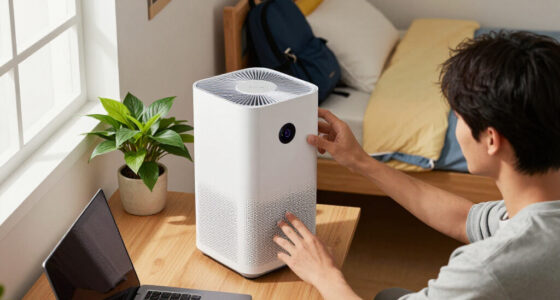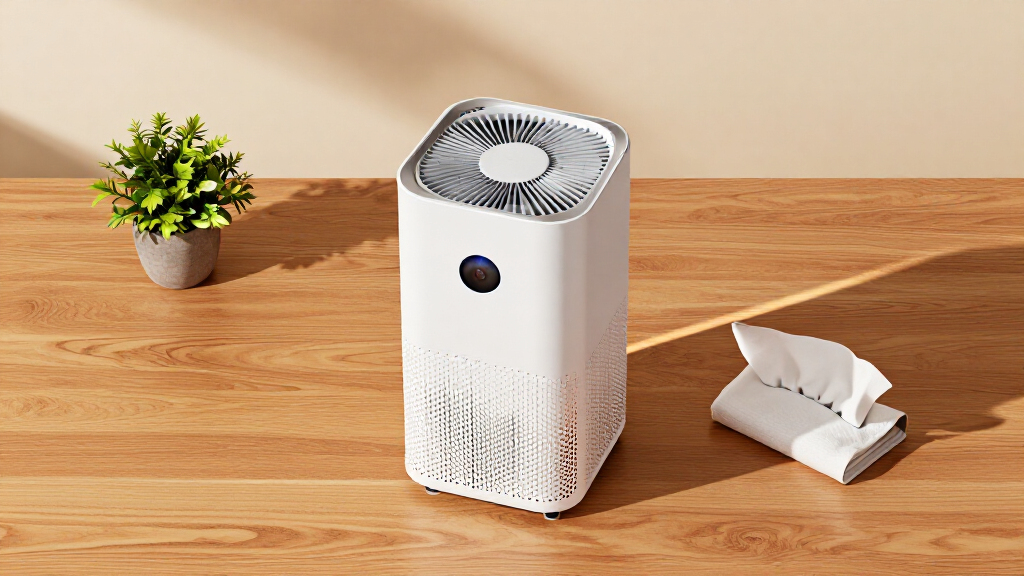
For portable air purifiers for allergies, my best overall pick is the Blueair Blue Pure Mini Max Auto for its compact design and automatic adjustment. The Levoit Core 300-P is a stronger choice when you need room-level cleaning, while the Pure Enrichment PureZone Mini suits personal-space use. The main tradeoff is that small, rechargeable units are easier to carry but usually clean less air than larger plug-in models. Filter type, room coverage, noise, and replacement needs matter as much as portability. Read on for the full breakdown of all eight options and how I’d match them to different allergy needs.

Get health and wellness essentials delivered free with Prime
- Fast, free delivery on millions of items
- Prime Video, Amazon Music and more included
- Member-only deals all year
Complete the kit



Key Takeaways
- Blueair Blue Pure Mini Max Auto leads for portable everyday use, while the larger Levoit Core 300-P is better suited to a room than a desk or travel bag.
- The lineup spans personal-space purifiers and room-sized units; choosing by the word “portable” alone can leave a bedroom under-served.
- Battery power offers freedom from outlets, but it does not replace checking airflow and coverage for the space where you plan to use the purifier.
- Several picks specify HEPA-type or True HEPA filtration, but buyers should compare the full filter system and replacement availability rather than rely on labels alone.
- The Westinghouse 1804 stands apart for its NCCO technology alongside H13 True HEPA, while its feature set may be more than a simple personal purifier user needs.
| 4WDKING Rechargeable Portable Air Purifier |  | Best for Personal, On-the-Go Airflow | Filter type: Japan H13 | Filtration efficiency: 99.9% | Battery life: 8–10 hours per charge | VIEW LATEST PRICE | See Our Full Breakdown |
| ConairPure Portable Rechargeable Air Purifier |  | Best for Tiny Personal Spaces | Filtration: HEPA-type filter (HEPA 10) | Additional technology: Plasma ion generator | Fan speeds: 2 | VIEW LATEST PRICE | See Our Full Breakdown |
| HoMedics Personal Air Purifier with HEPA-Type Filter and Activated Carbon | 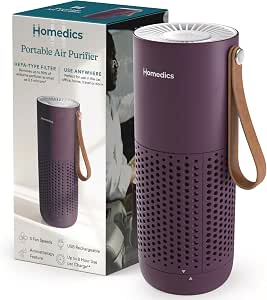 | Best for Adjustable Personal Use | Filter system: HEPA-type filter, activated carbon, and built-in prefilter | Particle removal: Up to 99% of airborne particles as small as 0.3 microns | Battery life: Up to 8 hours per charge | VIEW LATEST PRICE | See Our Full Breakdown |
| Blueair Blue Pure Mini Max Auto Air Purifier |  | Best for Small Bedrooms | Coverage: 105 sq ft at 4.8 ACH; up to 510 sq ft in one hour | Filtration: HEPASilent; captures at least 99.97% of airborne particles down to 0.1 microns | Odor control: Activated carbon filter for light household odors | VIEW LATEST PRICE | See Our Full Breakdown |
| TDBYWAE Air Purifier with True HEPA Filter |  | Best for Compact, Multi-Stage Filtration | Filtration: Pre-filter, True HEPA filter, and activated carbon filter | Coverage: Up to 600 sq ft | Air changes: 4 times per hour in 230 sq ft | VIEW LATEST PRICE | See Our Full Breakdown |
| Westinghouse 1804 Portable Air Purifier with NCCO Technology and H13 True HEPA Filter |  | Best for Travel with Two-Stage Filtration | Filter type: H13 True HEPA and NCCO | Coverage area: 10 square meters | Particle retention size: 0.3 micron | VIEW LATEST PRICE | See Our Full Breakdown |
| Levoit Core 300-P Air Purifier |  | Best for Larger Rooms | Filter type: 3-in-1 filtration | Filtration efficiency: 99.97% for particles 0.1–0.3 microns | CADR: 143 CFM smoke; 153 CFM dust; 167 CFM pollen | VIEW LATEST PRICE | See Our Full Breakdown |
| Pure Enrichment PureZone Mini Portable Air Purifier |  | Best Lightweight Personal Purifier | Filtration: Two-stage activated carbon pre-filter and True HEPA filter | Filtration efficiency: Eliminates 99.97% of germs | Coverage: 6 square feet in 12 minutes | VIEW LATEST PRICE | See Our Full Breakdown |
| portable air purifiers for allergie | Battery life | Filtration | Fan speeds | Noise level |
|---|---|---|---|---|
| 4WDKING Rechargeable Portable | 8–10 hours per charge | — | — | — |
| ConairPure Portable Rechargeab | Up to 22 hours on low | HEPA-type filter (HEPA 10) | 2 | — |
| HoMedics Personal Air Purifier | Up to 8 hours per charge | — | 3 | 17.5–34.0 dBA |
| Blueair Blue Pure Mini Max Aut | — | HEPASilent; captures at least 99.97% of airborne particles down to 0.1 microns | — | As low as 19 dB |
| TDBYWAE Air Purifier with True | — | Pre-filter, True HEPA filter, and activated carbon filter | 3 | — |
| Westinghouse 1804 Portable Air | — | — | — | 35 dB |
| Levoit Core 300-P Air Purifier | — | — | — | 24 dB in Sleep Mode |
| Pure Enrichment PureZone Mini | Up to 12 hours on low | Two-stage activated carbon pre-filter and True HEPA filter | 3 | — |
More Details on Our Top Picks
4WDKING Rechargeable Portable Air Purifier
The 4WDKING takes a different approach from room purifiers: it is worn close to your face, directing filtered airflow toward your nose and mouth rather than cleaning a whole room. Its Japan H13 filter is listed at 99.9% filtration efficiency, and the rechargeable battery is specified for 8–10 hours of use, making it suited to long outings where a tabletop unit would be inconvenient. Compared with the ConairPure, which is designed for a tiny 15-square-foot space, this model travels with the wearer instead of relying on a fixed location. The tradeoff is the wearable format: mounting it on your arm, neck, waist, or head may feel bulky, and it does not provide room-wide allergy relief. The filter element is rated for 500 hours, so replacement is part of ongoing upkeep.
Pros:- Japan H13 filter is specified at 99.9% filtration efficiency
- Runs for 8–10 hours per charge
- Adjustable wind speed lets users change airflow
- Can be mounted on the arm, neck, waist, or head
Cons:- Wearable design may feel bulky during extended use
- Filter element needs replacement every 500 hours
- Directs airflow to the wearer rather than purifying a room
Best for: People who want a rechargeable, wearable source of filtered airflow during commutes or outdoor activities.
Not ideal for: Anyone seeking to clean the air throughout a bedroom, office, or other shared room, or who dislikes wearing equipment.
- Filter type:Japan H13
- Filtration efficiency:99.9%
- Battery life:8–10 hours per charge
- Filter lifespan:500 hours per filter element
- Wind speed:Adjustable
- Power source:Rechargeable battery
- Mounting options:Arm, neck, waist, or head
Our verdict“Choose the 4WDKING for personal filtered airflow on the move, not as a substitute for a room air purifier.”
ConairPure Portable Rechargeable Air Purifier
The ConairPure suits a desk, bedside table, or other very small zone where a compact, cordless unit matters more than broad coverage. Its HEPA-type filter is designed to capture dust and pollen, while a plasma ion generator adds another pollutant-attracting method. Two fan speeds keep operation simple, and the stated battery life reaches 22 hours on low; that runtime applies to the lower setting, not every use. Unlike the wearable 4WDKING, the ConairPure sits in one place and treats a listed area of up to 15 square feet. That makes it easier to live with at a workstation, but a poor match for purifying an entire bedroom. Choose it for a close, small-space setup; look to the Blueair Blue Pure Mini Max for substantially larger stated coverage.
Pros:- Cordless operation supports placement away from an outlet
- Up to 22 hours of battery life on low
- HEPA-type filter is intended to capture dust and pollen
- Two fan speeds and quiet operation suit personal spaces
Cons:- Coverage is limited to up to 15 square feet
- The 22-hour runtime applies to low fan speed
- HEPA-type filtration is not specified as True HEPA
Best for: Desk workers, travelers, or dorm residents who want cordless filtration close to where they sit or sleep.
Not ideal for: People who need allergy-particle reduction across a full bedroom or other large room; its stated coverage is only up to 15 square feet.
- Filtration:HEPA-type filter (HEPA 10)
- Additional technology:Plasma ion generator
- Fan speeds:2
- Battery life:Up to 22 hours on low
- Operation:Corded or cordless
- Coverage area:Up to 15 square feet
Our verdict“Pick the ConairPure for quiet, cordless use in a very small personal area, but not for room-wide allergy filtration.”
HoMedics Personal Air Purifier with HEPA-Type Filter and Activated Carbon
The HoMedics Personal Air Purifier balances particle filtration and odor reduction in a rechargeable format. Its prefilter, HEPA-type filter, and activated carbon are described as removing up to 99% of airborne particles as small as 0.3 microns, while three fan speeds give more control than the two-speed ConairPure. A stated noise range of 17.5–34.0 dBA helps explain its appeal for desks, bedrooms, cars, and travel, though the battery lasts up to eight hours per charge. That is shorter than the ConairPure’s low-speed claim, but the HoMedics offers a more detailed three-part filter system and includes fragrance pads. Those pads add scent, not allergy filtration, and may not suit people sensitive to fragrance. Plan for filter replacement every two to three months.
Pros:- Prefilter, HEPA-type filter, and activated carbon work in combination
- Three fan speeds offer more adjustment than the two-speed ConairPure
- Noise is specified from 17.5 to 34.0 dBA
- Portable rechargeable design and three included essential oil pads
Cons:- Battery life is up to 8 hours per charge
- Filter replacement is recommended every 2 to 3 months
- Essential oil pads may not suit fragrance-sensitive users
Best for: People who move between a desk, car, and bedroom and want adjustable airflow plus particle and light odor filtration.
Not ideal for: Buyers who need all-day cordless operation, infrequent filter changes, or an unscented setup without optional fragrance accessories.
- Filter system:HEPA-type filter, activated carbon, and built-in prefilter
- Particle removal:Up to 99% of airborne particles as small as 0.3 microns
- Battery life:Up to 8 hours per charge
- Fan speeds:3
- Noise level:17.5–34.0 dBA
- Included accessories:3 essential oil pads
- Filter replacement interval:Every 2 to 3 months
- Suggested use:Bedrooms, home offices, cars, dorm rooms, travel, and desks
Our verdict“Choose the HoMedics for adjustable, portable filtration across several personal settings if its shorter runtime and regular filter changes fit your routine.”
Blueair Blue Pure Mini Max Auto Air Purifier
For allergy relief in a small bedroom or nursery, the Blueair Blue Pure Mini Max Auto has the clearest room-focused case in this group. Its HEPASilent filtration is specified to capture at least 99.97% of airborne particles down to 0.1 microns, and the washable fabric pre-filter can catch larger debris before it reaches the main filter. Unlike the personal HoMedics, this unit adds a PM2.5 sensor and Auto Mode, so fan speed can respond to detected particle levels without constant manual adjustment. Night Mode and noise as low as 19 dB make it a better fit for sleep spaces than a wearable purifier. Its limits are scale and odor control: coverage is rated at 105 square feet at 4.8 air changes per hour, and carbon is intended for light household odors.
Pros:- Captures at least 99.97% of airborne particles down to 0.1 microns
- Auto Mode uses a PM2.5 sensor to adjust fan speed
- Night Mode and noise as low as 19 dB suit sleep spaces
- Washable fabric pre-filter and 360° air intake support practical upkeep and placement
Cons:- Designed for small spaces, with 105 square feet specified at 4.8 ACH
- Activated carbon is described as helping with light household odors
- Room purifier format is less suited to travel than the rechargeable HoMedics
Best for: Allergy sufferers furnishing a small bedroom, nursery, or office who want sensor-led operation and quiet nighttime use.
Not ideal for: People who need a wearable purifier, cordless portability, broad whole-home coverage, or heavy-duty odor removal.
- Coverage:105 sq ft at 4.8 ACH; up to 510 sq ft in one hour
- Filtration:HEPASilent; captures at least 99.97% of airborne particles down to 0.1 microns
- Odor control:Activated carbon filter for light household odors
- Noise level:As low as 19 dB
- Air intake:360°
- Controls:One-touch controls, 3 fan speeds, Auto Mode, and Night Mode
- Pre-filter:Washable fabric
- Sensors:Particle (PM2.5) sensor
- Design:Compact, lightweight cylindrical design
Our verdict“Choose the Blueair for quiet, sensor-guided particle filtration in a small room rather than personal or on-the-go use.”
TDBYWAE Air Purifier with True HEPA Filter
The TDBYWAE pairs a compact body with a pre-filter, True HEPA filter, and activated carbon, giving it a broader stated target list than the ConairPure’s HEPA-type filter and plasma ion system. It is rated for up to 600 square feet, but the more useful allergy-focused figure is four air changes per hour in 230 square feet. The wider maximum-area claim should not be read as equivalent to that more frequent cleaning rate. Three fan speeds, a timer, Type-C charging, and a 16 dB sleep-mode rating add flexibility for bedrooms and travel. Compared with the room-focused Blueair Blue Pure Mini Max, the TDBYWAE claims a larger reach, but its supplied data gives less detail about particle capture performance and no air-quality sensor or Auto Mode. Its compact size is appealing; the coverage figures call for careful matching to room size.
Pros:- Three-stage filtration includes a True HEPA filter and activated carbon
- Four air changes per hour are specified for a 230-square-foot area
- Sleep mode is rated at 16 dB
- Type-C charging, three fan speeds, and timer settings add placement flexibility
Cons:- The 600-square-foot maximum coverage claim is paired with four air changes per hour only in 230 square feet
- No particle-capture percentage or minimum particle size is supplied
- Lacks the PM2.5 sensor and Auto Mode listed for the Blueair Blue Pure Mini Max
Best for: Buyers wanting a compact purifier with True HEPA and carbon stages for a small-to-medium room, plus timer and Type-C charging.
Not ideal for: People who want sensor-guided automatic operation, clearly stated fine-particle efficiency, or frequent air changes across the full 600-square-foot claim.
- Filtration:Pre-filter, True HEPA filter, and activated carbon filter
- Coverage:Up to 600 sq ft
- Air changes:4 times per hour in 230 sq ft
- Sleep mode noise:16 dB
- Fan speeds:3
- Timer:2, 4, or 8 hours
- Charging:Type-C
- Dimensions:8.4 x 8.4 x 5 inches
Our verdict“Choose the TDBYWAE if you want compact True HEPA and carbon filtration with flexible controls, while sizing it around its 230-square-foot air-change rating.”
Westinghouse 1804 Portable Air Purifier with NCCO Technology and H13 True HEPA Filter
The Westinghouse 1804 is the travel-focused pick for allergy sufferers who want more than a personal fan: its H13 True HEPA filter targets particles down to 0.3 microns, while NCCO technology is listed for odors and other pollutants. At 2 pounds, it is easier to pack than the room-sized Levoit Core 300-P, and its battery means it can run away from an outlet for up to 8 hours. That portability comes with a clear limit: coverage is only 10 square meters, so it is better suited to a small room or travel space than a shared living area. The Pure Enrichment PureZone Mini is lighter and lasts longer on low, but the Westinghouse offers a stated coverage area and H13 filtration. I would skip it for all-day use away from power or for large rooms.
Pros:- H13 True HEPA filtration captures particles as small as 0.3 microns.
- NCCO technology is paired with filtration for odors and other pollutants.
- Battery-powered design weighs 2 pounds and runs up to 8 hours.
- Listed coverage of 10 square meters helps set expectations for small spaces.
Cons:- Coverage is limited to 10 square meters, restricting use in larger rooms.
- Up to 8 hours of runtime may not cover a full day away from an outlet.
- At 11.18 × 8.43 × 7.2 inches, it takes more packing space than the PureZone Mini.
Best for: Travelers with pollen or pet-dander sensitivities who want a rechargeable purifier for a small hotel room or personal space.
Not ideal for: People who need continuous filtration through a full day without recharging, or allergy sufferers trying to treat a large shared room.
- Filter type:H13 True HEPA and NCCO
- Coverage area:10 square meters
- Particle retention size:0.3 micron
- Runtime:Up to 8 hours
- Noise level:35 dB
- Weight:2 pounds
- Dimensions:11.18 × 8.43 × 7.2 inches
- Power source:Battery
- Certification:ETL Certified
Our verdict“Choose the Westinghouse 1804 for portable H13 filtration in a small travel space, but not as a substitute for a large-room purifier.”
Levoit Core 300-P Air Purifier
For allergy control at home, the Levoit Core 300-P is the strongest room-focused option in this group: its pollen CADR of 167 CFM and 3-in-1 filter make it a more practical choice for a larger room than the cordless Westinghouse 1804 or PureZone Mini. It captures 99.97% of particles from 0.1 to 0.3 microns, including pollen and pet dander, and Sleep Mode runs at 24 dB with the display lights switchable off. The tradeoff is that this is not a travel purifier: it needs a 120V outlet and weighs 7.9 pounds. It also lacks Auto Mode and smart connectivity, so adjustments are manual. Filter replacement is recommended every 6 to 8 months. I would choose it for steady home use, but not for a suitcase or a buyer who wants automated controls.
Pros:- 3-in-1 filtration captures 99.97% of particles from 0.1 to 0.3 microns.
- Pollen CADR of 167 CFM makes it better suited to larger spaces than the portable battery models here.
- Sleep Mode operates at 24 dB, and display lights can be turned off.
- Includes a timer and check-filter indicator.
Cons:- Requires a 120V AC outlet, so it is not cordless or travel-ready.
- No Auto Mode or smart connectivity; controls require manual adjustment.
- Replacement filters are recommended every 6 to 8 months.
Best for: People with allergies who want a plug-in purifier for a bedroom or other larger home room and prefer quiet nighttime operation.
Not ideal for: Frequent travelers, buyers outside the United States who cannot use 120V power, or anyone wanting app control or Auto Mode.
- Filter type:3-in-1 filtration
- Filtration efficiency:99.97% for particles 0.1–0.3 microns
- CADR:143 CFM smoke; 153 CFM dust; 167 CFM pollen
- Maximum coverage:1,073 square feet
- Noise level:24 dB in Sleep Mode
- Power source:AC, 120V
- Weight:7.9 pounds
- Dimensions:8.7 × 8.7 × 14.2 inches
- Certifications:AHAM verified, FCC certified, ETL listed, CARB compliant
Our verdict“Pick the Levoit Core 300-P for quiet, plug-in allergy filtration in a larger room, not for portable use away from home.”
Pure Enrichment PureZone Mini Portable Air Purifier
The PureZone Mini makes the most sense when the goal is a cleaner pocket of air at a desk, bedside, or while traveling—not whole-room allergy control. Its under-1-pound body and rechargeable battery make it easier to carry than the Westinghouse 1804, and its runtime reaches up to 12 hours on low. A two-stage activated carbon and True HEPA filter is designed to address particles as well as odors, while three fan speeds let you trade airflow for quieter operation. The stated coverage is only 6 square feet in 12 minutes, so it cannot compete with the Levoit Core 300-P for room coverage. Battery life is also specified only on low, and the compact format means its benefit is personal rather than shared. I would choose it for portability, not as a room purifier.
Pros:- Weighs less than 1 pound and is designed for portable personal use.
- Rechargeable battery runs up to 12 hours on low.
- Two-stage activated carbon pre-filter and True HEPA filter address odors and airborne particles.
- Three fan speeds and an adjustable, removable handle add flexibility.
Cons:- Coverage is limited to 6 square feet in 12 minutes, making it unsuitable for room-wide filtration.
- The stated 12-hour battery life applies only to the low setting.
- Its compact personal-air focus offers less coverage than the Westinghouse 1804.
Best for: Commuters, students, and desk workers with allergies who want a lightweight purifier for close-range personal use.
Not ideal for: People seeking to reduce allergens throughout a bedroom or living room, or buyers who need a stated long runtime at higher fan speeds.
- Filtration:Two-stage activated carbon pre-filter and True HEPA filter
- Filtration efficiency:Eliminates 99.97% of germs
- Coverage:6 square feet in 12 minutes
- Battery life:Up to 12 hours on low
- Fan speeds:3
- Weight:Less than 1 pound
- Warranty:5 years
- Included accessories:2-in-1 filter and USB charging cable
Our verdict“Choose the PureZone Mini if you need a lightweight purifier close to you, but choose a room-sized model for broader allergy relief.”

How We Picked
I ranked these eight models for allergy-focused use by balancing particle filtration with practical portability. I looked at the filtration claims and filter setup, the intended space and airflow, power options, controls, noise considerations, and the routine burden of replacing or cleaning filters. A compact unit can be convenient, but it only earns a strong position if its intended use is clear and its cleaning capacity matches that use.
The order reflects the difference between personal-space and room-level needs, not a claim that one size fits every allergy sufferer. Models with useful everyday controls and a clearer balance of portability and cleaning potential rank ahead for broad use; more specialized rechargeable units suit narrow use cases, while larger plug-in purifiers score better for rooms than for travel. I also weighed distinctive technologies against added complexity, since features matter only when they serve the buyer’s space and habits.
| portable air purifiers for allergie | Filtration |
|---|---|
| 4WDKING Rechargeable Portable | — |
| ConairPure Portable Rechargeab | HEPA-type filter (HEPA 10) |
| HoMedics Personal Air Purifier | — |
| Blueair Blue Pure Mini Max Aut | HEPASilent; captures at least 99.97% of airborne particles down to 0.1 microns |
| TDBYWAE Air Purifier with True | Pre-filter, True HEPA filter, and activated carbon filter |
| Westinghouse 1804 Portable Air | — |
| Levoit Core 300-P Air Purifier | — |
| Pure Enrichment PureZone Mini | Two-stage activated carbon pre-filter and True HEPA filter |
Factors to Consider When Choosing Portable Air Purifiers For Allergies
Before choosing a model, decide where airborne allergens need to be reduced and how often the purifier will move. Portability is a use case, not a performance guarantee: a device that works near your face may not clean a whole bedroom. These factors can help you avoid paying for features that do not solve your particular problem.
Match Clean-Air Capacity to the Actual Space
Start with the room where you spend the most time, then compare its size with the purifier’s stated coverage and airflow information. A personal purifier may help create a cleaner zone at a desk or bedside, but it should not be treated as a substitute for a room-rated unit. For bedrooms, look for clear coverage guidance and consider whether the purifier can run for long periods without disturbing sleep. Open doors, high ceilings, and frequent movement between rooms can all make a nominal coverage figure less useful. A common mistake is choosing the smallest device because it is easiest to carry, then expecting it to clean a shared room. If the manufacturer does not give enough information to judge capacity, treat that uncertainty as a tradeoff rather than assuming broad coverage.
Read Filtration Claims Beyond the Label
Allergy-focused buyers should check what the filter is designed to capture and whether the device uses a sealed airflow path that directs air through the filter. “HEPA-type,” “True HEPA,” and a stated H13 grade are not interchangeable descriptions, so compare the exact claims rather than treating every label as equivalent. Activated carbon can help with some odors, but it does not replace particle filtration for pollen, dust, or dander. Also check whether filters are washable, replaceable, or intended for a limited service life. A low-maintenance promise may be appealing, yet a reusable prefilter does not necessarily mean the main particle filter needs no care. When specifications are vague, favor models with clearly explained filter construction and upkeep.
Choose Battery Power Only If You Need It
Rechargeable models make sense for commutes, travel, or locations without a convenient outlet, but battery operation brings limits on runtime and charging frequency. Check whether the advertised operating time applies at the speed you are likely to use; higher fan settings often consume more power and may be louder. If the purifier will sit in one place most of the time, a plug-in model may offer a simpler routine and better suitability for longer operation. For travel, think about how you will recharge it and whether the device can run while connected to power. A portable unit is most useful when its power arrangement fits your actual schedule, not just an occasional outing. Do not trade away adequate airflow for a battery feature you rarely need.
Account for Noise and Placement
Fan noise can determine whether a purifier runs consistently, especially beside a bed or in a quiet workspace. Look for noise information by fan setting when available, since a quiet low setting may move less air than a stronger allergy-season setting. Placement also affects usefulness: a unit tucked behind objects or placed where air cannot circulate freely may perform differently from one in an open spot. Personal purifiers work best when used close to the breathing zone, while room units need space for intake and exhaust. Consider whether controls are easy to reach and whether lights can be dimmed or switched off at night. A quiet purifier that stays on can be more practical than a louder model that gets turned off.
Plan for Filter Upkeep Before Buying
Filter replacement is part of the ownership decision, not an afterthought. Check which replacement filters fit the exact model, how often the manufacturer recommends changing them, and whether the supply is easy to find. Dusty homes, pets, and heavy seasonal pollen may call for more frequent attention than a lightly used office device. Some models also need prefilter cleaning, which adds a small but regular task. Buyers sometimes focus on the purifier’s feature list and only later discover that routine upkeep is inconvenient. Pick a maintenance schedule you can keep up with, because a neglected filter can undermine the point of running the device.
Decide When a Larger Unit Is Worth the Space
A larger purifier can be the better choice when allergies affect a bedroom or shared living area, even if it is less convenient to carry. More room-oriented models are generally designed for sustained use in a fixed location, while personal units prioritize size and mobility. Pay more for added capacity or specialized filtration only when those traits match the room and exposure you are trying to manage. If your main goal is cleaner air while working at a desk, a compact option may be the more sensible fit. If you need coverage across a room, a tiny rechargeable device can become a false economy by encouraging expectations it cannot meet. Think about whether you need one purifier for one zone or several devices for different spaces.
Frequently Asked Questions
Can a personal portable purifier clean an entire bedroom?
Usually, a personal-sized model is intended to clean air near one person rather than circulate all the air in a bedroom. Check the manufacturer’s room-coverage guidance and compare it with your room’s size before relying on it overnight. A bedside unit may still suit someone who wants a cleaner zone close to where they sleep, but it should not be assumed to replace a room-rated purifier. For whole-room use, prioritize airflow and coverage over compact size. If the specifications do not state a suitable room size, choose a model with clearer capacity information.
Is a rechargeable purifier a good choice for allergy relief while traveling?
It can be useful when you want a device near your seat or bedside and cannot count on having an outlet. Check runtime at the fan speed you expect to use, plus charging method and whether it can operate while plugged in. A compact purifier may help with personal-space air, but it cannot control allergens throughout a hotel room or other large space. For longer stays, a plug-in purifier with room-appropriate coverage may be a better fit. Treat battery life and intended area as separate questions rather than assuming portability means broad cleaning.
Should I choose a True HEPA model over a HEPA-type model?
Compare the exact filtration claims and supporting specifications instead of choosing by the label alone. “True HEPA” and “HEPA-type” can signal different filter standards, and neither tells the whole story about how air moves through the device. Look for details on the filter construction, airflow, intended coverage, and replacement parts. Also check whether the filter sits in a sealed path so air is directed through it rather than around it. If the product information leaves these points unclear, that is a meaningful drawback for an allergy-focused purchase.
Do I need activated carbon in a purifier for allergies?
Activated carbon is mainly relevant when odors or some gaseous pollutants are also a concern. For common airborne particles associated with allergies, particle filtration and suitable airflow should take priority. Carbon can complement a particle filter, but it does not make an undersized purifier suitable for a larger room. Consider whether odors are part of your problem before paying extra for a carbon layer or a more elaborate filter setup. If your priority is pollen, dust, or pet-related particles, compare particle-filter details first.
How many portable purifiers do I need if I use several rooms?
Start by identifying the rooms where you spend the most time rather than buying one small purifier and expecting it to cover a whole home. A portable unit can be moved between spaces, but it only cleans the room where it is operating and moving it frequently may interrupt consistent use. A room-sized purifier may suit the bedroom, while a personal model can serve a desk or travel need. Check coverage for each space and decide whether moving one device fits your daily routine. If you need cleaner air in several rooms at once, separate appropriately sized units may be more practical.
Conclusion
For most buyers seeking one versatile personal purifier, I’d start with the Blueair Blue Pure Mini Max Auto as my best overall pick. The 4WDKING Rechargeable Portable Air Purifier is my best-value-style choice for buyers who specifically want rechargeable portability, while the Westinghouse 1804 is the premium choice for shoppers drawn to its NCCO technology and H13 True HEPA filter. For beginners, the HoMedics Personal Air Purifier offers a straightforward personal-unit format; for desk or travel use, compare it with the Pure Enrichment PureZone Mini and other compact options. If you need to clean a room rather than a personal zone, choose the Levoit Core 300-P instead of expecting a small portable model to do that job. The best fit comes down to whether you need room coverage, battery freedom, or a compact unit close to your breathing space.