
TL;DR

Get health and wellness essentials delivered free — and shop member deals
- Fast, free delivery on millions of items
- Access to Prime Big Deal Days deals on October 6–7
- Prime Video, Amazon Music and more included
A study published online August 17 in the Chinese Medical Journal established age-specific anti-Müllerian hormone (AMH) reference values for Chinese women aged 35–55 using an ultrasensitive assay. The researchers report potential value for fertility counseling and assessment of perimenopausal symptoms, but say AMH alone is not accurate enough to diagnose menopause.
Researchers have developed an age-specific reference framework for anti-Müllerian hormone (AMH) in Chinese women aged 35–55, using an ultrasensitive test designed to measure the hormone at very low levels. The study, published online August 17 in the Chinese Medical Journal, reports associations with diminished ovarian reserve and perimenopausal symptoms; it does not establish AMH as a stand-alone test for menopause.
The team, led by Professor Yingying Qin of Shandong University in collaboration with Professor Ruimin Zheng of the National Center for Women and Children’s Health in China, used a large nationwide cohort to construct age-specific AMH reference values. The framework is intended to address a gap in reference ranges, which have often been based on women of reproductive age and may not give precise comparisons for those in the menopausal transition.
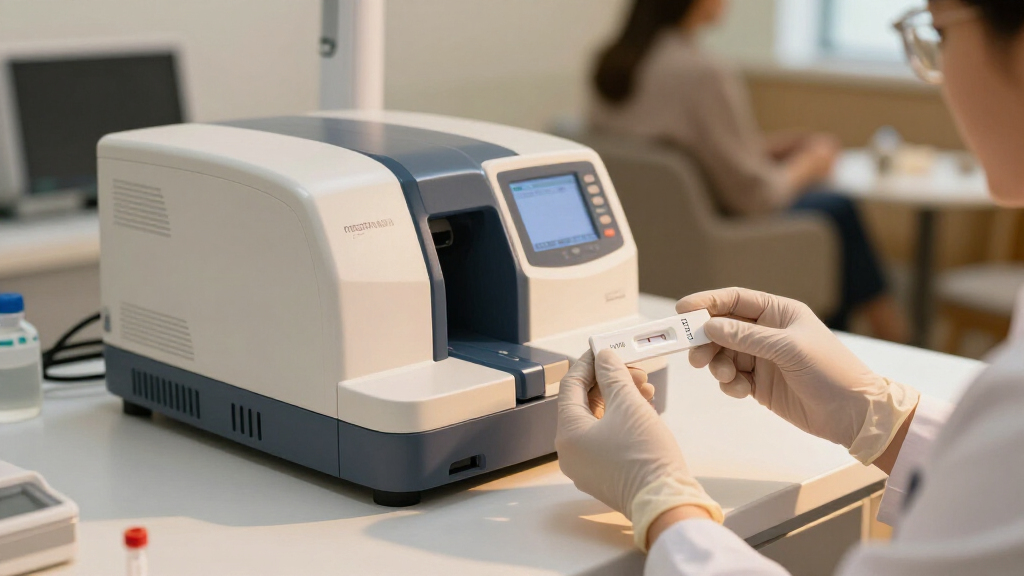
Conventional assays can have limited sensitivity when AMH concentrations are very low. The researchers used an ultrasensitive assay to measure those levels more precisely, particularly among women aged 44–49, whom the report describes as being in a near-depletion phase. The reference table lets clinicians compare a person’s result with values for women of the same age, rather than treating one result as meaningful without age context.
In a hospital-based care cohort, women aged 35–40 whose AMH was below the 10th percentile for their age were more likely to progress to severely diminished ovarian reserve, defined in the report as AMH below 0.25 ng/mL, than women in the normal percentile range. The report also says lower AMH was associated with a greater likelihood of more severe perimenopausal symptoms, particularly hot flashes and sweating. These are associations, not proof that a particular AMH level causes symptoms or predicts an individual’s experience.
Potential Uses in Midlife Care
The reference values could give clinicians a more age-calibrated way to discuss ovarian reserve with patients, including those considering pregnancy in their late reproductive years. For women aged 35–40 who hope to conceive, the reported link between AMH below the 10th percentile and subsequent severely diminished ovarian reserve may inform conversations about fertility planning. It does not determine whether a person can or will become pregnant.
The findings may also help clinicians consider ovarian hormone measurements alongside symptom reports during perimenopause. The researchers suggest AMH percentiles could complement symptom questionnaires when discussing care, including hormone replacement therapy when clinically appropriate. The study does not show that AMH testing alone should guide treatment or that using the reference table improves health outcomes.
For menopause assessment, the practical point is more limited: a very low AMH result may provide supporting information in some difficult cases, but should not replace clinical assessment or other tests. The reported performance indicates that the framework is a potential addition to care, not a definitive diagnostic tool.
As an affiliate, we earn on qualifying purchases.
Why Midlife AMH Ranges Matter
AMH is commonly used as a marker of ovarian reserve, but its interpretation depends on the person and the clinical question. The study focuses on women aged 35–55, a period that can include declining fertility, perimenopausal symptoms and uncertainty about menopausal status. The researchers argue that reference values tailored to age could make low results easier to interpret in this group.
The team also compared AMH among premenopausal and postmenopausal women. The report gives average levels of 0.187 and 0.043 ng/mL, respectively, describing a pronounced drop between the groups. However, the difference between group averages does not mean that one threshold can reliably classify every individual. The study reports an overall area under the curve of about 0.7 for AMH’s ability to distinguish menopausal status, which the report characterizes as moderate.
The research paper, by Xu and colleagues, is titled “Age-specific anti-Müllerian hormone reference values using an ultrasensitive assay: Associations with ovarian aging and menopausal transition symptoms.” It appeared online in the Chinese Medical Journal and is identified by DOI 10.1097/CM9.0000000000004161.
“AMH by itself is not sufficient as a stand-alone diagnostic test for menopause.”
— The study report
at-home ovarian reserve testing kit
As an affiliate, we earn on qualifying purchases.
As an affiliate, we earn on qualifying purchases.
Limits of the New Reference Values
The source material does not provide the cohort size, the full study methods, or detailed measures of uncertainty for the reported associations. It also does not specify how well the reference values apply to women outside the Chinese population. Further validation would be needed before assuming the same ranges or results hold across different populations and clinical settings.
The findings do not establish that low AMH causes perimenopausal symptoms, nor do they show that using the reference framework changes fertility or symptom-management outcomes. The reported relationship with severe ovarian reserve decline is a risk association, not a prediction that applies with certainty to each patient. The study also says AMH alone has only moderate performance for distinguishing menopausal status.
As an affiliate, we earn on qualifying purchases.
Validation Before Wider Use
The next step is further evaluation of the age-specific values in other populations and clinical settings, along with research testing whether the framework improves counseling or care decisions. The supplied report does not identify a planned follow-up study or a timeline for broader clinical adoption. For now, the reference table is a research-based aid that clinicians may consider alongside a person’s age, symptoms, reproductive goals and other relevant assessments.
People making fertility or menopause-related decisions should discuss test results with a qualified health professional. AMH values should not be used by themselves to diagnose menopause, determine fertility, or choose treatment.
As an affiliate, we earn on qualifying purchases.
Key Questions
What did the researchers develop?
They developed age-specific AMH reference values for Chinese women aged 35–55, using an ultrasensitive assay to measure low hormone concentrations.
Can AMH alone diagnose menopause?
No. The report describes AMH’s ability to distinguish menopausal status as moderate, with an overall AUC around 0.7. It may provide supporting information, but is not a stand-alone diagnostic test.
What did the study find about fertility planning?
In a hospital-based cohort, women aged 35–40 with AMH below the 10th percentile for their age were more likely to progress to AMH below 0.25 ng/mL than those in the normal percentile range. The result does not determine an individual’s chance of pregnancy.
Were lower AMH levels linked with perimenopausal symptoms?
Yes. The report says lower AMH was associated with a greater likelihood of more severe symptoms, especially hot flashes and sweating. This association does not show that low AMH causes those symptoms.
Can these reference values be applied to everyone?
The reported framework was developed for Chinese women aged 35–55. The supplied material does not establish whether the values apply equally to other populations or settings.
Source: rss
Halloween Picks
halloween
As an affiliate, we earn on qualifying purchases.