
TL;DR

Get health and wellness essentials delivered free with Prime
- Fast, free delivery on millions of items
- Prime Video, Amazon Music and more included
- Member-only deals all year
A study published in Frontiers in Aging found unusually high late-life survival among women in Bolotana, a Sardinian village. Researchers estimate that 13.8% of women who reach 70 there live to 100, compared with about 3.5% in Italy and 3.6% in the United States. The study documents a demographic pattern; it does not establish why it occurs or prove that Bolotana meets every definition of a blue zone.
A study of Bolotana, a village in Sardinia, found that women who reach age 70 have an estimated 13.8% chance of living to 100—higher than the study’s estimates for women in Italy and the United States. Published in Frontiers in Aging, the research raises the possibility that the community could be a newly identified longevity hotspot, while leaving the reasons for its survival pattern unresolved.
The researchers examined demographic records for the village, which has about 2,300 residents, and reconstructed life histories using civil records and church archives. Their analysis included 3,060 people born in Bolotana between 1900 and 1925, among whom the team documented 38 people who reached age 100. The study assessed survival after age 70, including the likelihood of reaching 100.
For women who reached 70, the researchers estimated a 13.8% probability of reaching 100. Their comparison figures were approximately 3.5% for women in Italy and 3.6% in the United States. The study also estimated that Bolotana women who reached 70 had nearly 21 additional years of life expectancy. These figures describe the populations and measures used in the study; they do not predict an individual person’s lifespan.
Age verification was central to the project. Researchers matched birth, death and baptismal records to check ages, drawing on archives that the study’s co-author, S. Jay Olshansky, said extend back centuries. The researchers also reported that six people aged 100 or older lived in Bolotana in 2024, a concentration they estimated to be about 11 times the U.S. prevalence. That comparison is the researchers’ estimate, not a measure of the causes of longevity.
What Bolotana’s Survival Figures Show
The study adds a village with a notably high estimated rate of survival from age 70 to 100 to research on exceptional longevity. Researchers use the term “blue zone” for communities associated with unusually long lives. Bolotana may warrant further investigation under that framework, but the study’s findings are best read as evidence of a distinctive local pattern, not proof that residents share a single explanation for living longer.
Reliable age records also matter to longevity research, where claims about extreme ages can be difficult to verify. By comparing multiple types of records, the team says it was able to check the ages of the centenarians in its analysis. If other researchers can examine and replicate the findings, Bolotana could offer a useful case for studying how local histories and population patterns shape survival in old age.
The results do not establish that a particular diet, level of exercise or family structure causes longer life. They also do not show that any one practice can be transferred elsewhere to produce the same outcome. The value for readers is in the research question: identifying a population pattern can guide further study, while causal conclusions require more evidence.
Products Worth Considering

Fitbit Inspire 3 Health and Fitness Tracker Bundle

Fitbit Versa 2 Health and Fitness Smartwatch with Heart Rate, Alexa, Music, Sleep and Swim Tracking

Fitbit Sense Health & Fitness Smartwatch (White/Gold, International Version)
As an affiliate, we earn on qualifying purchases.
How Bolotana Fits Sardinia’s Longevity Research
Sardinia already has a long-standing place in longevity research. A previously identified area of the island is known for unusual longevity among men. In Bolotana, by contrast, the study highlights women’s survival in later life. The researchers report that Bolotana women ranked second to Hong Kong in international comparisons of life expectancy at 70 and the probability of reaching 100.
The village first drew the team’s attention because of its reported concentration of centenarians. The researchers then used records spanning more than a century to test whether the ages and survival pattern could be supported by documentary evidence. The resulting paper, by Giovanni Mario Pes and co-authors, was published in Frontiers in Aging in 2026.
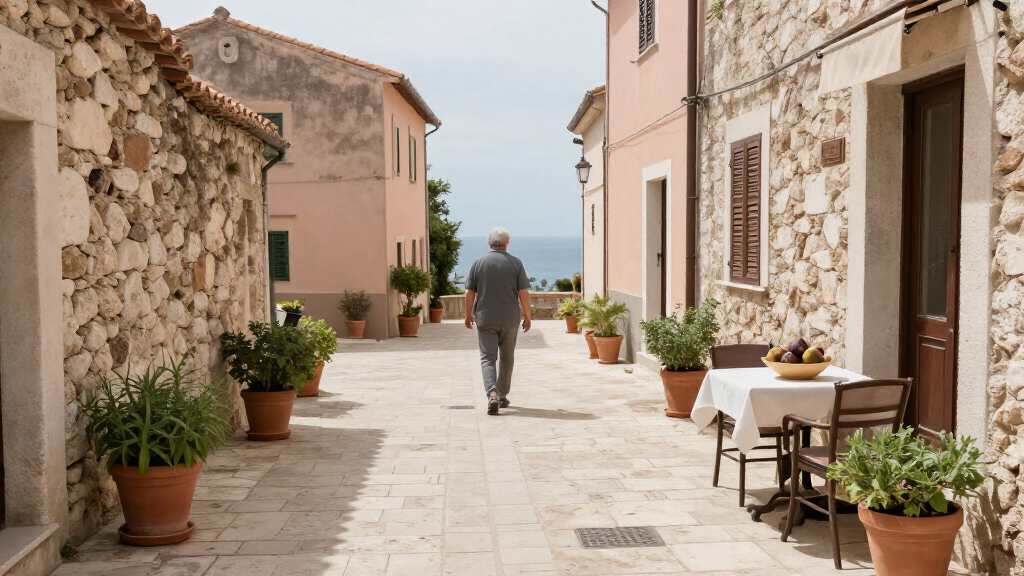
Olshansky said the setting may offer leads for future research: Bolotana has steep, walkable streets, locally produced food, and families that often live near one another. Those are observations and possible factors, not findings that the study tested as causes. The authors point to diet, physical activity, social support and genetics as areas that may merit investigation.
“What makes Bolotana extraordinary is that it has an incredible historical record that allows us to definitively evaluate ages at birth and death.”
— S. Jay Olshansky, study co-author and professor emeritus of epidemiology at the University of Illinois Chicago School of Public Health
Why Residents Live Longer Remains Unknown
The study identifies a survival pattern; it does not explain its causes. Although the researchers mention diet, walking, family support, social connection and genetics as possible contributors, the reported analysis does not establish how much each factor matters or whether any causes the observed outcomes.
The results also do not settle whether Bolotana should be formally classified as a blue zone. The report describes it as a possible newly identified example, and the study’s findings would need to be considered alongside the criteria used to define such communities. Further work would also be needed to assess how the estimates compare across populations and how the historical records and study methods affect the results.
The figures are population estimates based on the study’s records, not guarantees for individuals. The report does not provide a complete account of the researchers’ limitations, the uncertainty around each estimate, or what steps are planned to test potential explanations. Those details remain important for interpreting the findings.
Further Research Must Test Possible Causes
The immediate next step is to investigate which features of Bolotana’s history and daily life could be linked to its late-life survival pattern. The study points to possible lines of inquiry, including physical activity, food, social ties and genetics, but does not report a tested causal explanation.
Further comparisons with other populations and scrutiny of the records and methods could help show how robust the estimates are and whether similar patterns appear elsewhere. The report does not specify a timetable for follow-up research or announce a formal decision on blue-zone status. Until more evidence is available, Bolotana is best described as a promising research case rather than a confirmed explanation for exceptional longevity.
Key Questions
What did the Bolotana study find?
Researchers estimated that 13.8% of women who reach 70 in Bolotana live to 100. Their comparison estimates were about 3.5% for women in Italy and 3.6% for women in the United States.
Has Bolotana been confirmed as a blue zone?
No formal confirmation is described in the report. The findings suggest Bolotana may be a newly identified longevity hotspot, but further assessment is needed.
How did researchers check residents’ ages?
The team matched birth, death and baptismal records from civil and church archives to verify ages, according to study co-author S. Jay Olshansky.
What explains the higher survival estimates?
The study does not establish a cause. Researchers named diet, walking and other physical activity, family support, social connection and genetics as possible factors for further study.
Source: rss